
Strategic and Prospective
Dominant
position in the Murchison
Historical
high-grade gold plus new Vadrians discovery
Three
Distinct Project Areas
ISLAND GOLD PROJECT
Advancing a high-grade gold discovery of scale
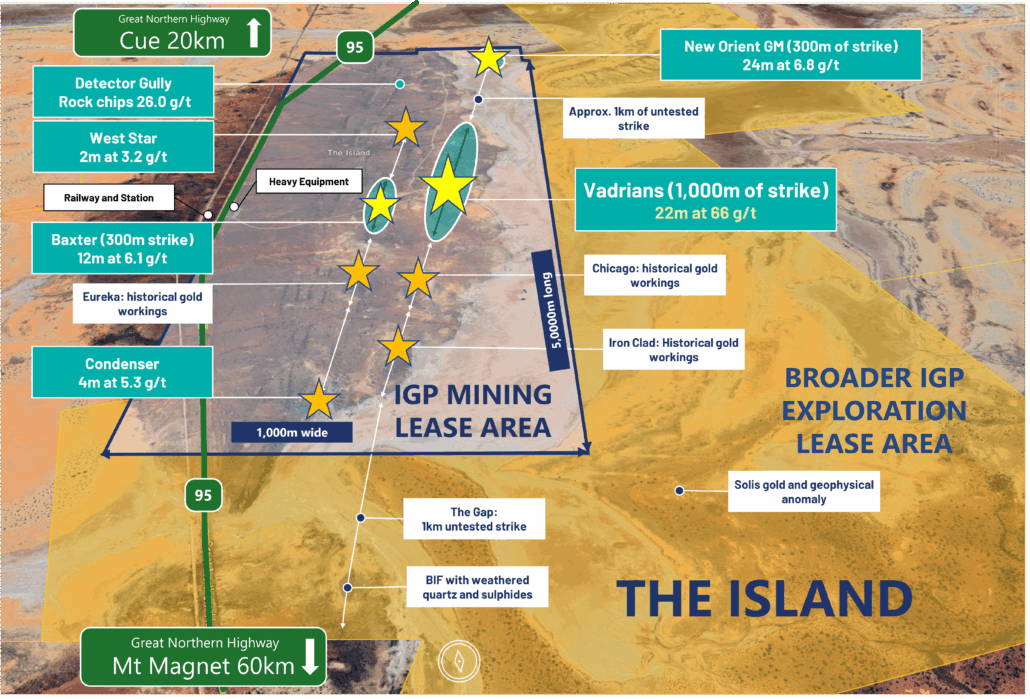
Caprice’s flagship Island Gold Project is located in the Murchison region of Western Australia and hosts extensive gold mineralisation across an approximately five-kilometre structural corridor. The Project is located within 50km of established mining and processing centres in the Cue, Mount Magnet and Meekatharra districts, providing access to existing regional infrastructure and potential third-party processing opportunities.
Exploration at Island is focused on a series of favourable Banded Iron Formation units, mafic rocks and structurally controlled positions associated with the regional Boogardie Breaks and northwest-trending cross-cutting structures. Gold mineralisation extends from the historical New Orient gold mine in the north to the Ironclad prospect in the south, highlighting the potential for multiple mineralised positions across the broader Island corridor.
Caprice’s exploration programme incorporates air-core, reverse circulation and diamond drilling to define and extend mineralisation at Vadrians, test parallel and repeat mineralised positions, assess emerging prospects across the broader Island corridor and refine the geological and structural model.
The exploration programme is also focused on generating the drilling density and technical information required to support a future Mineral Resource Estimate, while testing additional regional targets across the Island mining tenure.
Recent exploration has continued to strengthen Caprice’s understanding of the geological and structural controls on mineralisation at Island and highlights the potential for multiple mineralised zones across the broader corridor. With mineralisation remaining open in several areas, ongoing exploration is focused on expanding known mineralisation, testing new targets and advancing the Project towards a future Mineral Resource Estimate.
Watch our recent videos here
COMET GOLD PROJECT
Under-explored greenstone belt along strike
from the Island Gold Project
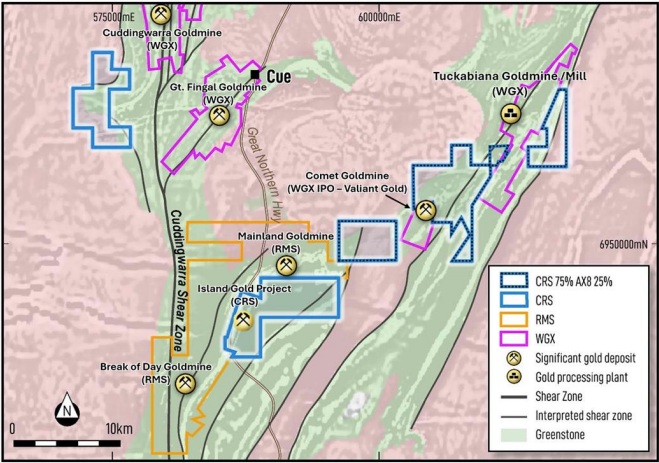
The Comet Gold Project is located 22km southeast of Cue, with excellent access via the sealed Cue–Wondinong Road, which crosses the northern portion of the tenure. Several historic mining and station tracks provide good internal access.
Comet comprises three granted tenements (E20/908, E20/1000 and E21/213), forming Combined Reporting Group C169/2021, covering approximately 68km².
Gold mineralisation within Comet is primarily associated with Silicified Iron Formation units, the same host rocks that underpin mineralisation at the Island Gold Project and nearby multi-million-ounce deposits, reinforcing the Project’s strong discovery potential.
Caprice continues early-stage field exploration at Comet, marking the start of systematic work aimed at confirming, prioritising and progressing multiple target areas. Initial activities include on-ground reconnaissance and mapping, access assessments, and the establishment of a pipeline of high-quality gold drill targets in preparation for drill testing.
CUDDINGWARRA GOLD PROJECT
Emerging gold targets in a proven belt
The Cuddingwarra project is located 540 km north-east of Perth and 10 km west of the town of Cue in Western Australia. It resides in the Murchison Greenstone Domain, within the Youanmi Terrane of the Archaean Yilgarn Craton, and is highly prospective for Archaean orogenic gold mineralisation.
The project includes two separate tenement packages that straddle the north-south striking Cuddingwarra Shear Zone (CSZ). The CSZ hosts the historic Cuddingwarra open pit mining centre, currently held by West Gold Resources; these historic deposits are directly adjacent to the Caprice Resources Cuddingwarra tenements.
The geology is dominated by a north-south striking sequence of basalt, high-Mg basalt, andesite, and ultramafic units. The sequence is variably intruded by felsic to mafic dykes and sills and is folded to the south-west with a large-scale south-east plunging anticline. Second-order shears from the CSZ and smaller linking structures have disrupted and deformed the greenstone sequence and are broadly associated with gold mineralisation. Stratigraphy in the south-west is partly obscured by transported sediments. The Cuddingwarra West tenements are bordered by large granitic intrusions.
Previous exploration has focused on mapping, soil and auger sampling, with a small number of historic AC drillholes adjacent to the historic Cuddingwarra open pit mining centre.
Caprice has commenced a soil sampling campaign at Cuddingwarra, targeting newly identified gold trends along a northeast-trending corridor. The program follows up on mapped cross-cutting structures and areas of previously identified visible gold.
The structures under investigation are geologically comparable to those associated with Westgold’s open pit operations at Cuddingwarra. Sampling is focused 500 m east of Westgold’s historical workings.