Caprice Resources
Level 2, 7 Havelock Street
West Perth WA 6005
Australia
T: +61 8 6141 3136
F: +61 8 6315 6421

Granted Mining Leases
Distinct Project Areas
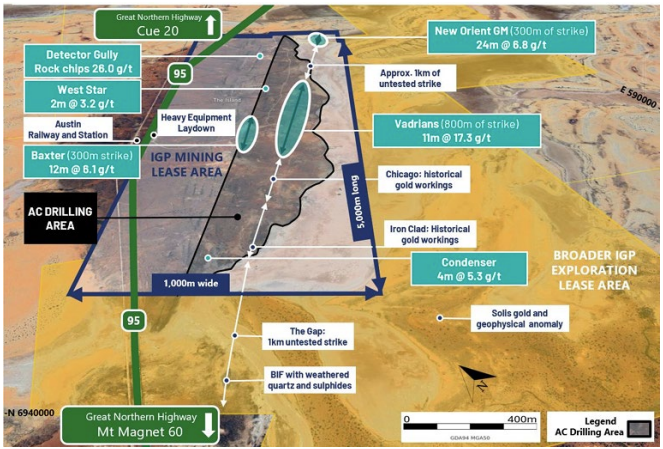
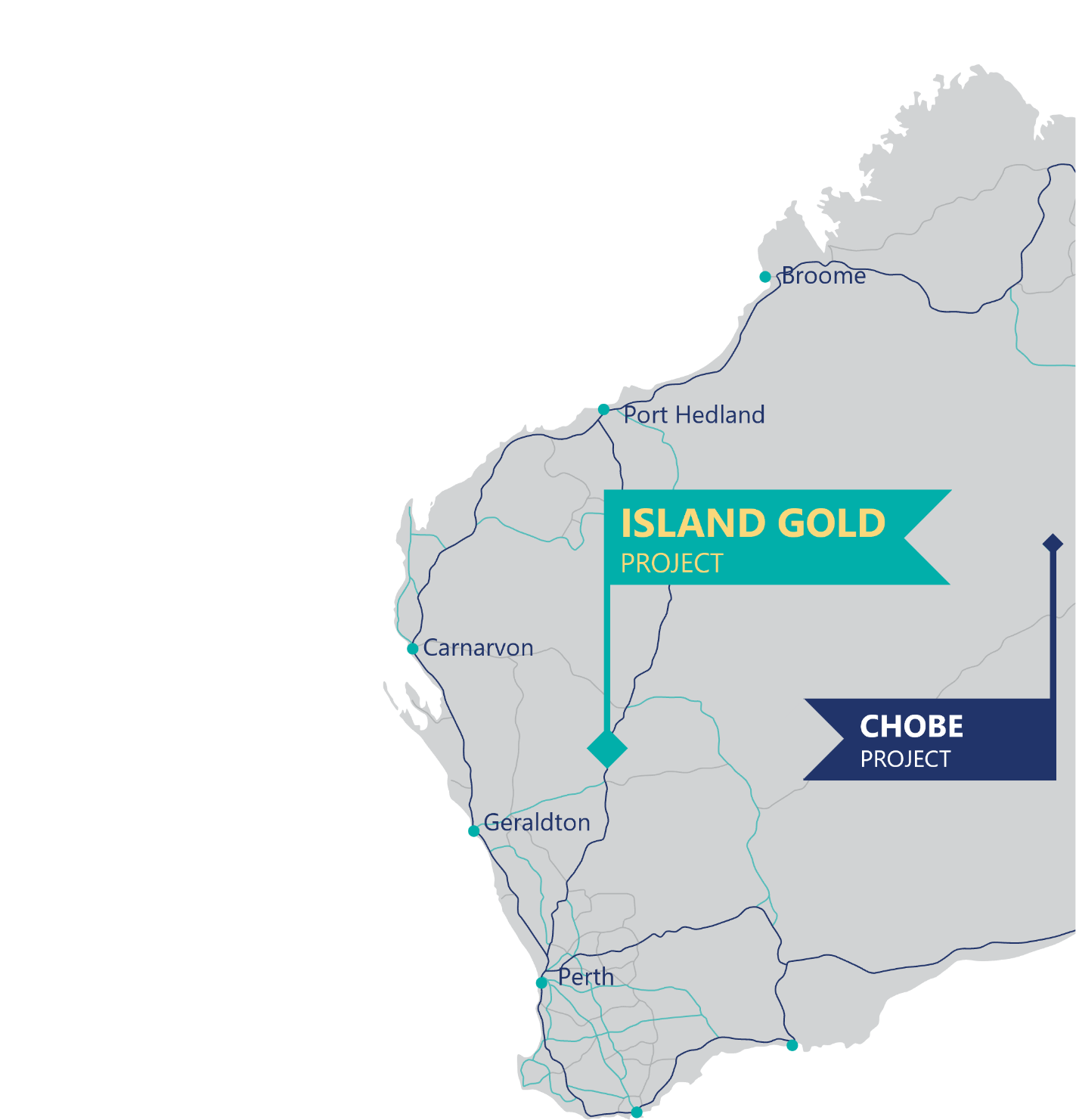
Caprice’s flagship Island Gold Project, located in Western Australia’s prolific Murchison Goldfields, hosts extensive high-grade gold mineralisation across a five-kilometre structural corridor. The project lies within 50km of several established mining and processing hubs that rely on consistent third-party ore feed.
Gold mineralisation extends over a 5km strike from the historical New Orient gold mine in the north to the Ironclad prospect in the south, following a sequence of BIF units up to 30m thick. This is a proven geological setting for large-scale, high-grade gold systems throughout the region.
Until late 2024, drilling was largely limited to shallow vertical depths averaging just 70m. Recent Caprice drilling has confirmed plunge orientations and expanded high-grade gold zones at depth. The discovery of mineralisation 80m west of New Orient, at the new West Star and Condenser lodes, both open to the north and down dip, highlights the potential for stacked gold lodes across the full corridor.
Importantly, the geological and structural characteristics at Island Gold mirror those of other high-grade deposits within the +15Moz Murchison Goldfields. BIF units and key NNW–SSE cross-cutting structures are known to host en échelon quartz veins and reef-style lodes within fold zones, providing a robust framework for continued exploration success.
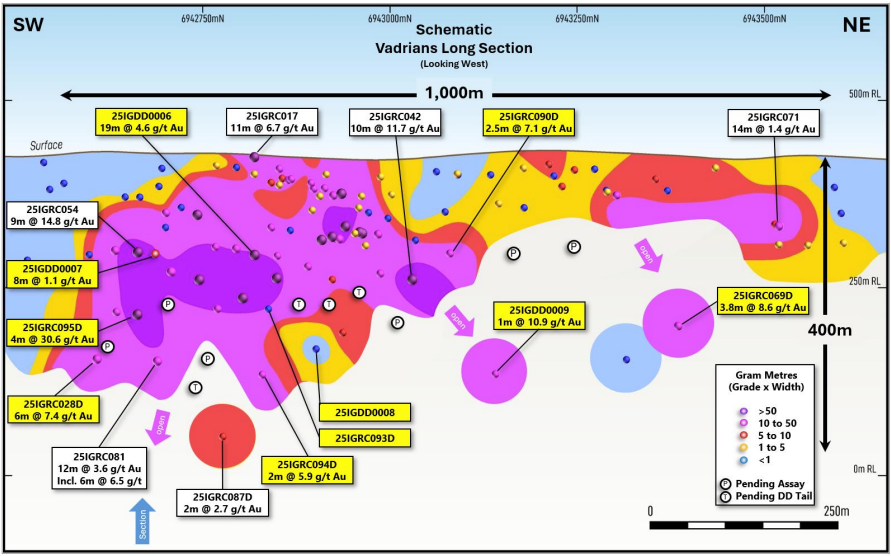
Assay results for 10 holes in the third batch of Phase 4 drilling have returned further high-grade gold results. Results confirm continuation of gold mineralisation along strike to the north, high-grade continuity with depth and a new high-grade gold quartz reef grading 1.2m at 14.4 g/t gold within a mafic host rock located in the footwall of the Vadrians banded iron formation (BIF) hosted system, adding yet another growth gold target.
Drill hole 25IGRC069D intersected 3.8m at 8.6 g/t gold from 281m downhole, including 2m at 15.6 g/t gold at the northern end of Vadrians, highlighting the potential for additional high-grade shoots. The gold system remains open at depth and along strike with further drilling planned in the remainder of Phase 4.
Drilling has recommenced at the Island to complete the outstanding 1,000m of diamond and 6,000m air core drilling scheduled in the Phase 4 Programme. The programme has been designed to systematically extend and refine the Company’s understanding of the Island Gold mineralised system, with a particular focus on Vadrians, while also advancing broader corridor-scale targets hosted within BIF units.
Diamond drilling is targeting strike, dip and down plunge extensions at Vadrians, with the primary objective of testing continuity of gold mineralisation at depth and supporting ongoing geological interpretation. The Company intends to use the results to refine targeting, improve confidence in the structural model, and guide future drill planning.
The air core component of the programme is targeting the wider BIF units across the Island Gold Project tenure. This programme is aimed at identifying and prioritising additional mineralised positions and structural settings along the corridor, including areas with limited historical drill coverage. Results will be used to define follow-up RC and diamond drill targets in future drilling campaigns.
Watch MD Luke Cox’s latest ⌚60-Second Update
Watch MD Luke Cox’s latest Field Update
The Comet Gold Project is located 22km southeast of Cue, with excellent access via the sealed Cue–Wondinong Road, which crosses the northern portion of the tenure. Several historic mining and station tracks provide good internal access.
Comet comprises three granted tenements (E20/908, E20/1000 and E21/213), forming Combined Reporting Group C169/2021, covering approximately 68km². The acquisition provides Caprice with a significant, contiguous landholding in a highly prospective part of the Murchison Goldfields.
Geologically, Comet lies immediately north and along strike of the historical Comet gold mine, within the Meekatharra–Mount Magnet Greenstone Belt, at the southern end of the Tuckabianna Shear Zone. To the east, mafic and ultramafic sequences BIF units are folded into a syncline, while to the west, felsic and mafic units form an antiform. Granitoid intrusions to the east and west provide favourable structural and lithological settings for gold mineralisation.
Importantly, Comet covers portions of two mineralised corridors, the Comet Trend and the Tuckabianna Trend, both of which host multiple significant gold deposits. These corridors present a robust structural and geological framework for further discoveries.
Gold mineralisation within Comet is primarily associated with Silicified Iron Formation (SIF) units, the same host rocks that underpin mineralisation at the Island Gold Project and nearby multi-million-ounce deposits, reinforcing the Project’s strong discovery potential.
Caprice has commenced early-stage field exploration across its newly acquired Comet Project ground, marking the start of systematic work aimed at confirming, prioritising and progressing multiple target areas. Initial activities include on-ground reconnaissance and mapping, access assessments, and the establishment of a pipeline of high-quality gold drill targets in preparation for drill testing.
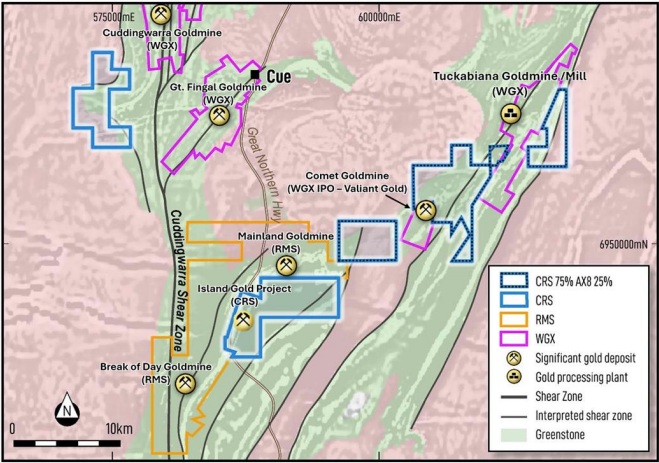
The Cuddingwarra project is located 540 km north-east of Perth and 10 km west of the town of Cue in Western Australia. It resides in the Murchison Greenstone Domain, within the Youanmi Terrane of the Archaean Yilgarn Craton, and is highly prospective for Archaean orogenic gold mineralisation.
The project includes two separate tenement packages that straddle the north-south striking Cuddingwarra Shear Zone (CSZ). The CSZ hosts the historic Cuddingwarra open pit mining centre, currently held by West Gold Resources; these historic deposits are directly adjacent to the Caprice Resources Cuddingwarra tenements.
The geology is dominated by a north-south striking sequence of basalt, high-Mg basalt, andesite, and ultramafic units. The sequence is variably intruded by felsic to mafic dykes and sills and is folded to the south-west with a large-scale south-east plunging anticline. Second-order shears from the CSZ and smaller linking structures have disrupted and deformed the greenstone sequence and are broadly associated with gold mineralisation. Stratigraphy in the south-west is partly obscured by transported sediments. The Cuddingwarra West tenements are bordered by large granitic intrusions.
Previous exploration has focused on mapping, soil and auger sampling, with a small number of historic AC drillholes adjacent to the historic Cuddingwarra open pit mining centre.
Caprice has commenced a soil sampling campaign at Cuddingwarra, targeting newly identified gold trends along a northeast-trending corridor. The program follows up on mapped cross-cutting structures and areas of previously identified visible gold.
The structures under investigation are geologically comparable to those associated with Westgold’s open pit operations at Cuddingwarra. Sampling is focused 500 m east of Westgold’s historical workings.