Caprice Resources
Level 2, 7 Havelock Street
West Perth WA 6005
Australia
T: +61 8 6141 3136
F: +61 8 6315 6421

Strategic and Significant Ground
Key Rare Earth Targets Delineated To Date
Sampling To Date Indicates High Magnetic Rare Earth Component
The Mukinbudin REE Project consists of one tenement, E70/5939, covering 384km2. The Project is located approximately 25km northwest of the town of Mukinbudin, 250km northeast of Perth. The region has received limited historical exploration for rare earths, however recently discovered pegmatite and clay hosted REE occurrences within the district has highlighted the potential for Mukinbudin as a new frontier for REE exploration.
Access to the Project is gained via sealed roads from Perth or Merredin, with many unsealed roads crosscutting the tenement, facilitating excellent access across the Project. The tenement overlies freehold farming properties, so on-ground access to key areas will require agreements with land holders.
The Project area almost entirely resides over granite to quartz-monzonite intrusions of the Archaean Yilgarn Craton. Local variations in the composition and textures of the intrusives suggest a complex intrusive sequence that includes fluorite bearing quartz monzonites, syenites and zoned pegmatites. The region is crosscut by late dolerite dykes, predominantly occupying an east to northeast trend. Structurally, the region is dominated by the large-scale lobate geometry of the granitoids, and several large scale north-north-east striking faults.
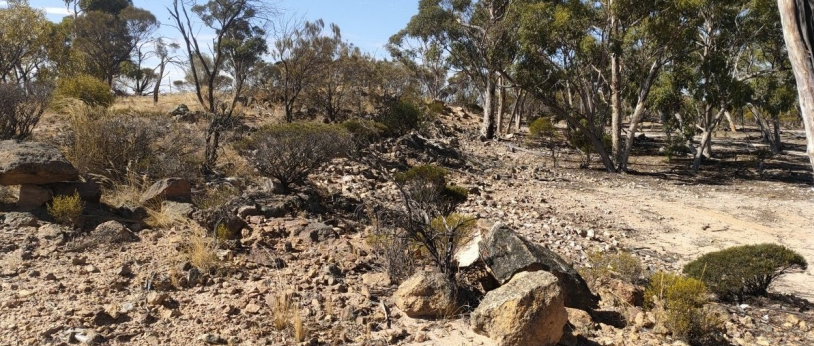
Pegmatites within the region have been the focus of exploration and mining since the 1970’s, primarily for high purity quartz and potassium feldspar. Several of the larger quarry operations have historically been mapped, providing evidence of compositional zonation within the pegmatites of the region (this includes the historical Mukinbudin Pegmatite quarry, the Karloning Pegmatite quarry, and the Gillet’s Pegmatite quarry).
Caprice made steps to extend the previously defined Gadolin prospect, specifically to the west and south, and was highly encouraged by preliminary results. Assays indicated that anomalism greatly increased stepping east and west away from the intercepted emplacement structure initially targeted. The protolith remained the widespread, regional fractionated porphyritic granite, and steps were taken to delineate terrain that suggested clay anomalism.
Gadolin’s strike stood at +3.4km, and with a defined 1.8km overall width, the exploration team remained encouraged that anomalism was open in all directions. Of note, the southern trend indicated a high-grade channel of +2500ppm over 800m and remained open. Sampling had been completed over 380m spaced lines and 80m spaced samples in the west, and probative 800m spaced lines and 80m spaced samples in the south. Caprice had planned follow-up sampling and infill programs, though these were not conducted at that time.
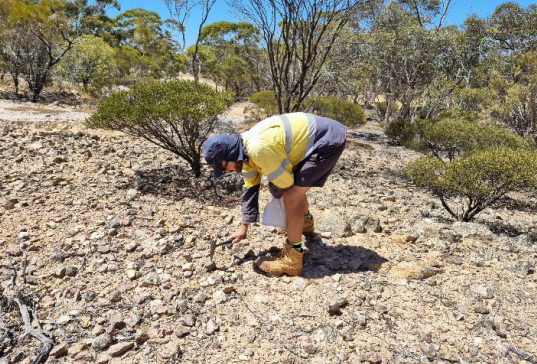
Rock chip sampling of an outcrop of porphyritic, fractionated granite, located approximately 2km north of Gadolin, delineated an area of consistently elevated REOs. This area, termed Colosseum, had 20 rock chip samples collected over a c.500m area. Of these, 13 returned values over 1,000ppm, with a peak value of 5,038ppm (0.5%) TREO and a lowest value of 310ppm TREO. Previous sampling had successfully identified a series of northwest-trending anomalies, with a peak value of 2,812ppm TREO, within a broader N-S trend. The anomalism remained open to the south, with infill sampling, extending in all directions, defined to 160m spaced lines and 40–80m spaced samples.
Follow-up sampling at Hadrian’s identified elevated levels of rare earths outside the previously defined target areas, significantly expanding the known potential strike of mineralisation at the prospect. With a number of samples still outstanding at the time, the Caprice team remained confident that Hadrian’s could be elevated to a drill-ready target alongside Gadolin and Colosseum. Follow-up and infill soil sampling had been undertaken to the north and south, with anomalism defined over 160m spaced lines and 80m spaced samples, over a 3.5km north–south strike, primarily focused around a prominent topographical feature. The quartz-aplite ridge crosscut NW–SE anomalism trends, and early mapping suggested a NNE-oriented shear.